Entries. Where doooo they all come from?
Entries are needed for many reasons. You may need an entry to dummy to cash a trick in another suit. You may need an entry to dummy in order to take a finesse. You may need an entry to draw trumps. The list is endless.
Having seen the need for entries, you have to go a bit farther to see where entries come from. Ideally, an entry is right there in the form of a high card that will win a trick. Some entries are ephemeral, requiring a finesse to do the trick.
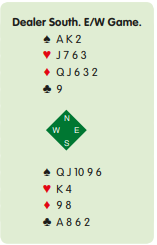
How would you rate the needed entries in the following hand?
Dealer South. E/W Game.
| West | North | East | South |
|---|---|---|---|
| Pass | |||
| Pass | 1♦️ | Pass | 1♠️ |
| Pass | Pass | Dbl | 2♠️ |
| All Pass |
North opens 1♦️ in third seat and passes South’s 1♠️ bid. This is fair bridge since North does not want South to go looking for a game. East makes a balancing double. What should South do? I suggest one of two bids. He can bid 2♠️, counting on North to have three of them. It is bad practice to open in third seat and then pass your partner’s response with one or two cards in his suit. South, expecting that North won’t bid this way, is entitled to bid as if North has a minimum opener with three (or four) spades. A second choice of bids is for South to redouble, showing a maximum passed hand. If South chooses 2♠️, a reasonable bid, he buys the contract.
The opening lead is the ♣️J. You need eight tricks. Where will they come from? Consider your play before reading on.
“It does not do to leave a live dragon out of your calculations, if you live near him.”
— J.R.R. Tolkien, The Hobbit
“Give me six hours to chop down a tree and I will spend the first four sharpening the axe.”
— Abraham Lincoln
A logical play is to win the club and ruff a club in dummy. That gives you seven tricks and another will come from a second club ruff or from the ❤️K. East did double and he may have the ❤️A. Who knows? If you can get the ❤️K and another club ruff, you might make an overtrick. But for the moment, let’s try to get trick number eight in and then worry about trick number nine.
Having ruffed a club with the ♠️2, what do you do next? Most declarers, when faced with a hand like this one, lead a heart to the king. This time it was taken by West’s ❤️A. West switched to a trump and South now needed to find a way to his hand in order to get another club ruff. There was no way back to his hand, though, and South went down one.
Here is the complete deal:
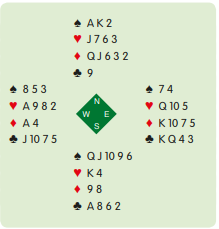
Given a club lead, a normal choice, South is cold for eight tricks. He does it by making sure he has the entries needed to ruff clubs twice. Those entries may not be immediately visible now but the play will make it clear.
Win the club ace at trick one and ruff a club. But be careful in your choice of what you ruff with. You saw that ruffing with the ♠️2 did not work. Try ruffing with the ♠️K. Now you can try a heart to the king but when it fails, you can win the trump switch in your hand. Another club ruff gets you eight tricks. There is no defence to this line of play.
As an aside, note East’s double. This is a balancing double. Balancing is an ugly topic since balancing often requires you bid with hands that do not have much to offer.
On this deal South stopped in 1♠️. East took the view that he was close to take-out double shape and he was sure that West had some points. Why else would North-South stop in 1♠️ if they had real hands? The effect of East’s balancing bid was that North[1]South got to 2♠️, a contract that might or might not make. As shown, some South players would go down in 2♠️, making East’s decision to balance a big winner.