by Mike Lawrence
Entries. I once played a hand with Tobias Stone (1919–2012), one of the great players and personalities of all time.
He did not play bridge in later life and chose to play some chess instead, winning a major tournament – and added one more laurel to an already crowded head.
Some years ago, we were playing in Juan Le Pins, in France, where we had acceptable results, if not winning results. One hand in particular stuck out.
Our opponent played in 4♠️. Declarer won the opening lead, drew trumps, and went about his business. After winning the first nine tricks, he pointed to dummy which was good. Four winners. He said he was making all 13 tricks. Tobias objected since he knew that declarer could not get there. It seemed that declarer had been so busy setting up his winners that he forgot to allow for an entry to get to them. He was down one in 4♠️.
Since other declarers around the room were routinely making 13 tricks, with some bidding 7♠️, this board was worth a complete top to us.
This article and the next seven will discuss entries. Sometimes the entry will be to dummy. But some of the time the entry will be to your hand. Regardless of where you need to be, you need to be able to get there. In many cases, you will be playing matchpoints where extra tricks count for something.
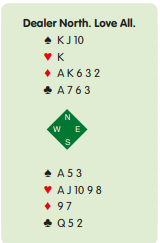
The hand below is from a teams event where making your contract is the most important thing.
Dealer North. Love All.
| West | North | East | South |
|---|---|---|---|
| Pass | 1♦️ | Pass | 1❤️ |
| Pass | 2♣️ | Pass | 2NT |
| Pass | 3NT | All Pass |
Dummy puts down his hand with some pride and notes that he made a very conservative rebid of 2♣️.
“This ought to be easy,” he says after displaying his wares.
West leads the 4♠️. The most common scenario is this: South spots that he has been given a free finesse and he plays the J♠️ from dummy. Today, that play results in East playing the Q♠️. South wins and goes about the heart suit.
South makes a good play by felling the K♥️ with the ace. He continues hearts, knocking out the Q♥️, and later plays a club toward his Q♣️. If East has the king, South will get three spades, four hearts, two diamonds, and two clubs. That adds up to eleven tricks, a fine day’s work.
But something bad happens. West has the K♠️ and South can’t get to his hand for the hearts.
South tries to set up a trick in the minors but can’t do it.
Contract down.
Did North bid too much? You would be hard pressed to convince him. Or was something else at work?
There is a better line and if you have not spotted it, I will show you the complete deal.
Full Deal
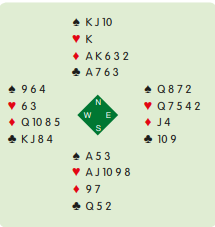
One of the things that is often stated but often overlooked is the rule that you should count your tricks.
Here, you predict three in spades, four in hearts, two sure diamonds, and one club. This adds up to ten tricks.
The next thing you have to inspect is your entries.
You can set up the four hearts by using the thoughtful overtaking play in hearts, but you must keep an entry to your hand. The answer is obvious if you ask yourself what can go wrong.
Win the spade lead with the K♠️. Then play on hearts by overtaking the K♥️ with the ace and continuing the suit.
Eventually, you will come to your ace of spades and you will take at least nine certain tricks.
Managing your entries was the key.