UK Edition • 31st August 2026

UK Edition • 31st August 2026
A weak two opening indicates a six-card suit and 5-9 or 6-10 points (the precise range being a matter for partnership agreement, perhaps depending upon the vulnerability). Although occasionally a weak two will have a seven-card suit (especially in a 7222 shape when vulnerable) or a five-card suit (at favourable vulnerability, third in hand, for example), responder will assume precisely six cards.
On many hands with a doubleton or fewer cards in partner’s suit, responder should pass. With up to and including 14 points, the high card values for game will not be present. With only a moderate or no fit, you will neither wish to increase the pre-empt nor be able to count shape points to boost you towards the values for game.
The usual responses are as follows:
Some play that a new suit is non-forcing, though this puts extra pressure on the 2NT enquiry.
On hands wishing to invite game in partner’s suit, you make the 2NT enquiry. This leaves the simple raise as a pre-emptive move.
A double raise to game covers one of two hand types. The first is a moderate or even weak hand (depending upon shape and vulnerability) with four-card or longer support. The second is a strong hand with at least a doubleton support. Opener does not need to know which hand type you hold, because the golden rule after opener pre-empts is that responder is captain and makes the subsequent decisions. With the strong hand, responder will double (or take some other suitable action) if the opponents compete.
How strong do you need to be to make the 2NT enquiry? You should have at least the values to invite game. With a doubleton in support, you are looking at a minimum of around 15/16 points. With three-card support, especially if you have a ruffing value, you will need a fraction less; with only a singleton, you need a bit more. With 17/18 points or so, you intend to reach game even facing a minimum and will only use the 2NT enquiry if you are unsure what the final contract will be. You might be interested in a slam or playing in 3NT, for example.
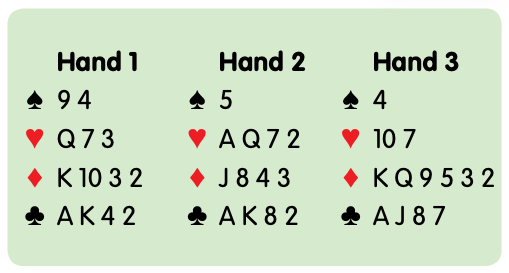
With Hand 1, you pass a weak 2♠️ from partner. Although you would have had enough to open the bidding had you been dealer, you cannot envisage game facing a weak two opener. You would, however, raise a weak 2❤️ to 3❤️. With your nine-card fit, you might well make 3❤️. Even if not, you make it hard for the opponents to enter the auction. You are bidding to the level of your fit.
With Hand 2, again you pass a weak 2♠️ opening. With no fit and 14 points facing a hand too weak for a one-level opening, you are not making game. If, instead, partner opened 2❤️, you would raise all the way to 4❤️. With four-card support and a singleton on the side, you might well make 4❤️. By getting to your final contract quickly, you make it as hard as possible for the opponents to get together in spades. You are bidding to the level of your fit again.
With Hand 3, you should pass either a weak 2❤️ or a weak 2♠️. If you change the suit, you will be raising the level and you have no reason to suppose that your diamond suit is any better than partner’s major. Remember, you are expecting partner to hold a six-card suit.
I have left the 2NT response until last because opinions vary about the best way for opener to reply. It is important that the reply discloses whether opener is minimum or maximum. One popular method, ‘Ogust’, involves showing the strength of the long suit (rather than high cards or short suits on the side):
3NT = maximum with A-K-Q in suit
3♣️ = minimum with poor suit
3♦️ = minimum with good suit
3❤️ = maximum with poor suit
3♠️ = maximum with good suit
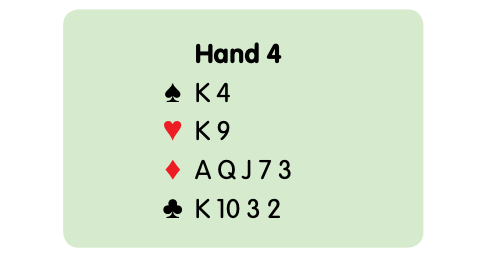
With Hand 4, you bid 2NT over 2❤️ or 2♠️. You intend to bid game in partner’s major facing a maximum and to sign off in three of the suit facing a minimum.